
When Q1 started in Albert Park, there was action from the start. The first 7 minutes of Qualifying signalled the start of a new season of Formula 1 racing.
A new Qualifying format promised lots of action, adding the element of elimination to the three knockout sessions of Q1, Q2 and Q3.
After that initial 7 minutes, however, chaos ensued. What initially looked exciting from a fan’s perspective, quickly turned into a nightmare for the drivers and teams.
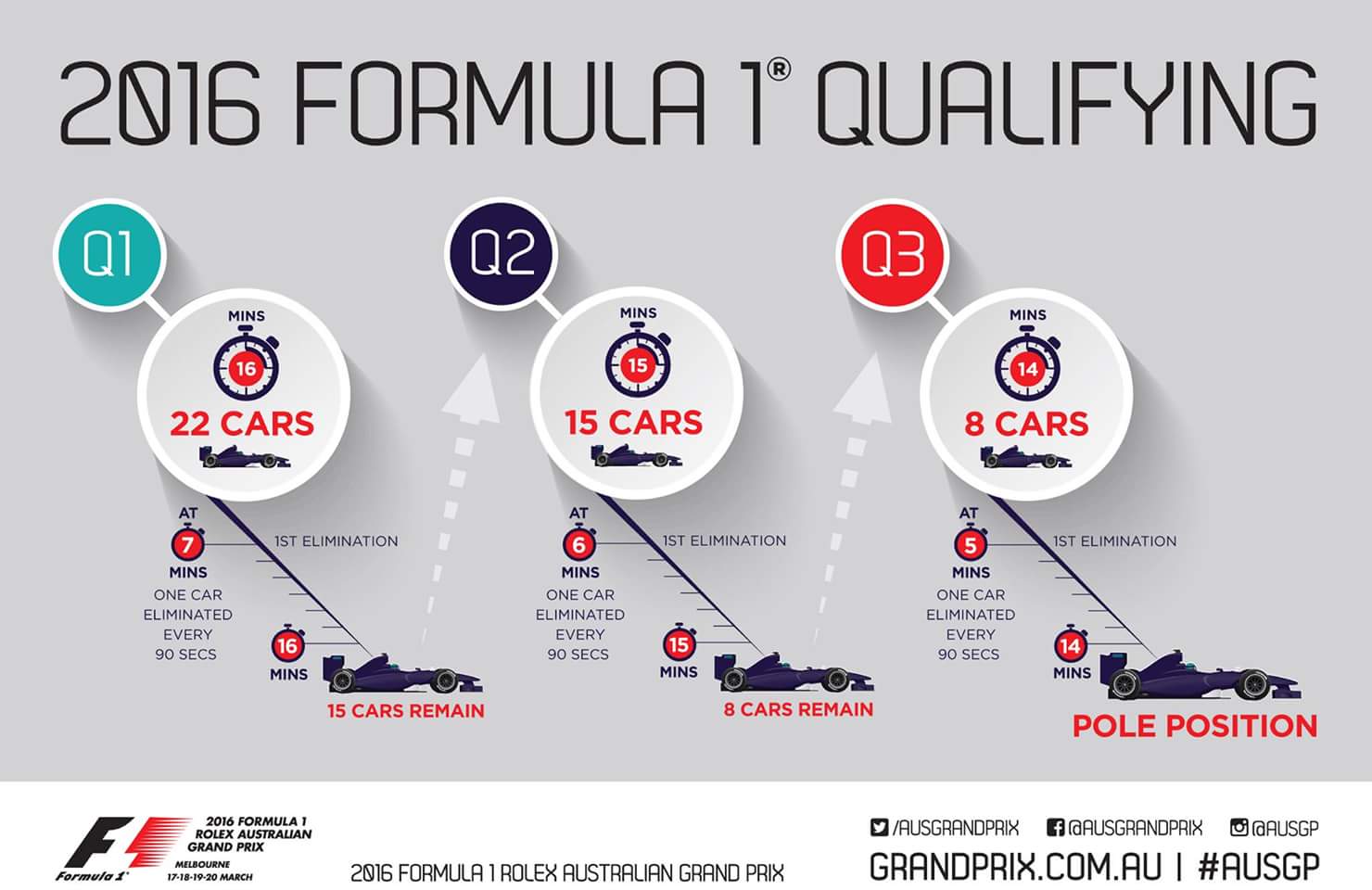
A new Qualifying format – but at what cost?
After setting one timed lap, the drivers had to pit for new tyres. This was due to Pirelli, on F1’s instructions, making tyres that don’t last for an entire session – to create excitement through varying pit stop strategies over the course of a racing weekend.
With every driver elimination occuring at 90 second intervals, this meant that the drivers near the bottom of the order didn’t have sufficient time to come back out of the pits, drive around the track and then start a new timed lap to rescue themselves from the elimination spots.
Sauber’s Felipe Nasr was one of the drivers to be caught out by the timings, as were Manor drivers Pascal Wehrlin and Rio Haryanto.
Romain Grosjean, driving for the Haas F1 Team, was on a timed lap – his redemption lap – only to be told over team radio, with three corners to go, that he was eliminated, with no chance to rescue himself from elimination.
Absolute Confusion… or not?
Whoever decided to improve qualifying three weeks before the start of the F1 season, needs now to decide why he/she made that call. None of the drivers seemed prepared, much less their teams, and nobody knew what was happening.
This meant that there was complete and utter confusion, and actually, a lack of on-track action.
The only people who seemed to know what was going on, was the FIA and race organisers (see above infographic).
The lack of a 90 second timer graphic, both on TV and on the pit wall, meant that on the day the teams were not able to predict when to let their drivers go out – or who was next to be eliminated – until it was too late.
One of the aims of the new qualifying format was to cut down on the number of drivers slowing down at the end of a lap – to create space between them and the car in front, but which often had the knock-on effect of getting in the way of the driver behind them (with time running out) and ruining that person’s fast lap – and then receiving a penalty for impeding other’s laps.
Another aim was to mix up the grid and catch out the big teams and drivers, by having an all-out race for the fastest lap, with all the drivers remaining on the circuit for the full amount of time in each session.
However, this didn’t happen: as the old knockout system of Q1, Q2 and Q3 was still in place, after one or two timed laps, the top 10 peeled into the pits, and left the rest of the drivers to squabble over the final grid positions in each session.
As Q2 came to an end, and Q3 began, the drivers who knew they were going to be eliminated, didn’t bother to go out on track again.
The result was that, in the final six minutes of Q3, six of the eight drivers in contention for pole position retreated back to the pits, knowing they couldn’t compete with the times set by the fastest two drivers, Hamilton and Rosberg.
This left the track almost empty.
Sergio Perez, who was sitting in 9th at the time, didn’t bother to return to the track, with Force India teammate Nico Hülkenberg’s 90 seconds of doom quickly drawing to a close.
Only the Mercedes, then?
Inevitably, this left only the Mercedes duo of Nico Rosberg (4th) and Lewis Hamilton (provisional 1st), to fight it out for pole position.
They were the only two cars out on track – not exactly the action that was promised by the format change.
During the final three minutes of Q3, Rosberg sat in 2nd, with Hamilton in 1st – with nobody apart from themselves out on the circuit.
When Hamilton and Rosberg then returned to the pits, having secured a Mercedes 1-2, there were still two whole minutes left of the session, but with nobody out on track.
It was a complete contrast to the ‘old‘ format, first introduced in 2006, which always had a top 10 shootout for pole position in the dying seconds of Q3.
Ferrari’s Sebastian Vettel, the nearest rival to the Mercedes duo, even had enough time (which he would not have had last season) to change into his jeans and waltz around the paddock for those final few minutes of Q3.
A shake-up gone wrong
The only thing that changed with the updated Qualifying format, was when the drivers went out onto the track.
To avoid being eliminated, the top drivers went out first, set a fast lap then returned to the pits.
When it became clear to the teams that the 90 second intervals were insufficient (due to the time it takes to lap the circuit), the drivers went out for one lap, then returned to the pits and awaited their imminent elimination, one-by-one, with nobody bothering to go out and fight for grid positions.
Under the old format, however, these drivers would have set a fast lap, retreated to the pits, and then waited until moments before the end of each knockout session – when the track was ‘rubbered-in‘ and at its core temperature – to go back out and set an even faster lap.
Although that meant drivers sometimes impeding other’s laps, it meant there was action for an entire session – the whole intention of the new-for-2016 qualifying shake-up.
Conclusion
Intentions aside, the only positive thing to come out of an otherwise disorganised qualifying format was that Hamilton qualified in his 50th pole position, a feat only matched by two other drivers – his hero Ayrton Senna, and Michael Schumacher.
Unfortunately, this was rather overshadowed by the shambles that ensued thanks to the new qualifying format – which made a mockery of F1, the FIA and their organisational skills.
An emergency meeting to discuss reverting back to the old 2006-2015 system has been organised for tomorrow, Sunday 19 March. All the teams are expected to attend and vote in favour of reverting back to that qualifying format.

 KPH car blog